Automatic Irrigation System
An automatic irrigation system is a solution to help maintain systematic irrigation of your plants.
This system allows you to schedule rules according to the plants' needs. This ensures savings in water and time, whether you have a garden or vegetable patch, or for large-scale agricultural irrigation systems.
Now let's describe an example of an automated irrigation system that can be built simply but with great automation potential.
Materials Used
- 1 Franzininho WiFi board
- 1 Soil moisture sensor - Hygrometer with digital and analog output
- 1 830-point breadboard
- 1 5V submersible mini water pump
- 1 5V relay
- Jumper wires - Male/Male and Male/Female
Electronic Circuit
For the example below, make the following assembly:
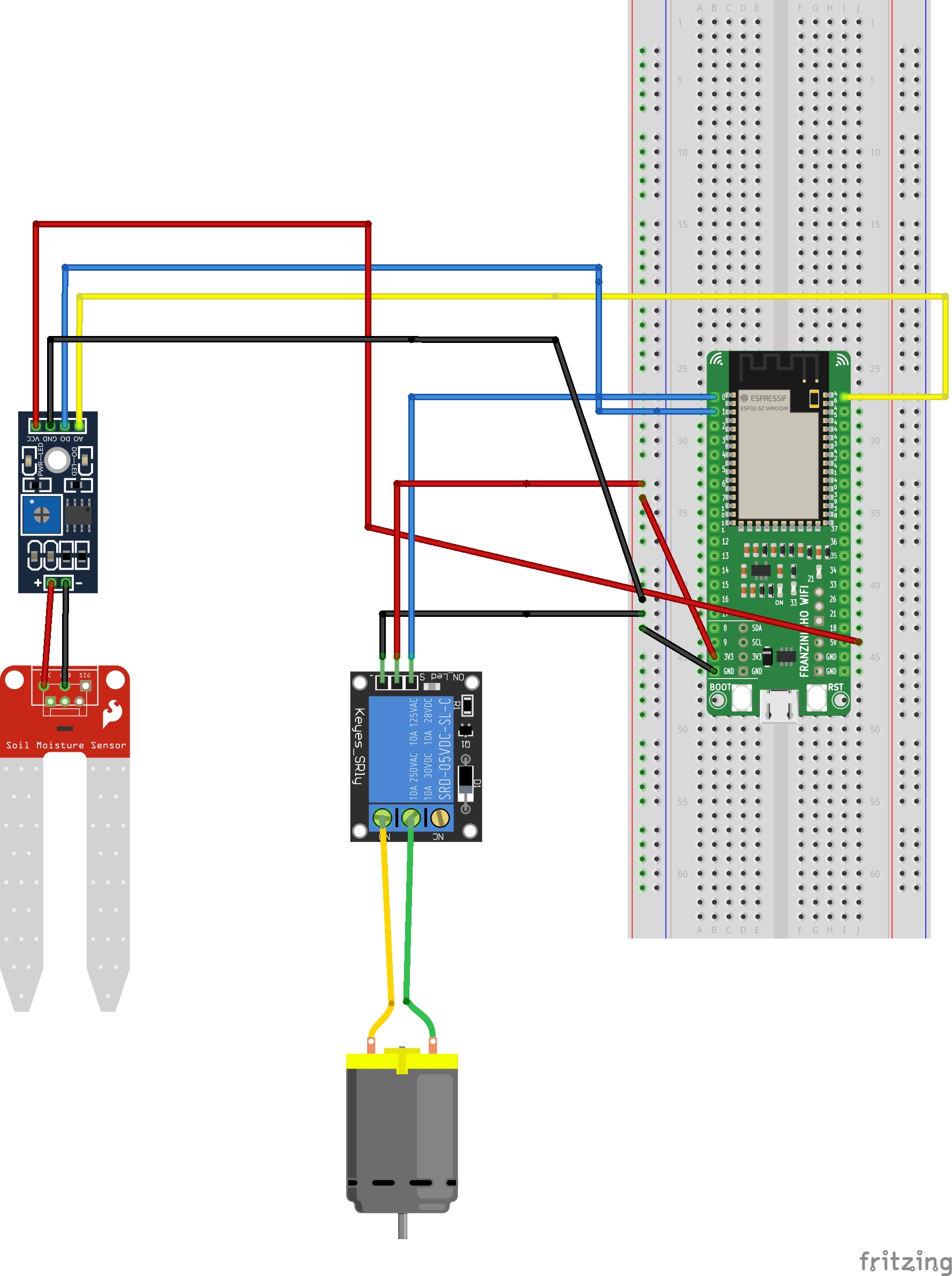
Notes:
- The relay is connected to the board's 5V
- Blue wires: digital outputs
- Red wires: VCC
- Black wires: GND
Source Code
To start, you must have followed the Getting Started tutorial (also available on the Franzininho documentation page), have CircuitPython installed on the board, and for this project we use the Mu editor. To set up this environment, just follow the steps in Installing the Tools.
From here on we assume that the installation and environment setup steps have been completed. Below is the system code on the board using CircuitPython. You can copy and paste the source code into your IDE.
import board
import time

from digitalio import DigitalInOut, Direction, Pull
from analogio import AnalogIn

relay = DigitalInOut(board.IO0)
relay.switch_to_output()

humid_analog = AnalogIn(board.IO1)
humid_digital = DigitalInOut(board.IO4)
humid_digital.direction = Direction.INPUT

relay.value = True

wait_time = 1
watering_time = 1

dry_value = 51130

while True:
    try:
        print("humid (Digital value):", humid_digital.value)
        print("humid (Analogic value):", humid_analog.value)

        time.sleep(1);

        if humid_analog.value > dry_value :
            print("Starting watering...")

            relay.value = False

            time.sleep(watering_time)
            print("Finishing watering.")

        else:
            relay.value = True
            time.sleep(wait_time)

    except RuntimeError as e:
        print("Read failure")

    time.sleep(1)
After finishing writing and reviewing in the development environment, just save and click on serial to run in the mu-editor. If you are using another IDE, just run it in your chosen environment.
Understanding the Source Code
The first module we will import is board. It enables access to the board pins:
import board
This module provides various time-related functions:
import time
The digitalio module contains classes to provide access to basic digital I/O:
from digitalio import DigitalInOut, Direction, Pull
Creates an object and connects the object to an analog input:
from analogio import AnalogIn
Now, let's assign the relay:
relay = DigitalInOut(board.IO0)
relay.switch_to_output()
We assign the analog and digital inputs of the soil moisture sensor to port 1 (analog) and port 4 (digital) of the Franzininho, also configuring the pin as a digital input:
humid_analog = AnalogIn(board.IO1)        # analog
humid_digital = DigitalInOut(board.IO4)   # digital
humid_digital.direction = Direction.INPUT
The relay was configured to use the "normally closed" port, so we need to set it to True to keep the relay inactive:
relay.value = True
Time period to check the system. The control of this time period to maintain plant watering depends on the voltage powering the pump:
wait_time = 1
watering_time = 1
Adjusted according to the soil moisture sensor. You need to run some tests with your soil to find the value for the soil you will use:
dry_value = 51130
Finally, inside the while True, our loop, we read the sensors continuously and print the values from the soil moisture sensor:
while True:
    try:

        print("humid (Digital value):", humid_digital.value)
        print("humid (Analogic value):", humid_analog.value)

        time.sleep(1);
In the condition below, if the sensor receives a value indicating the soil is dry, we enter the if condition and connect the relay to "normally closed". Adding False to "normally closed" means open. This way the pump is activated and irrigation begins:
if humid_analog.value > dry_value :
            print("Starting watering...")

            relay.value = False

            time.sleep(watering_time)
            print("Finishing watering.")
If the level is OK, we just make sure the relay is closed:
        else:
            relay.value = True
            time.sleep(wait_time)
And we put the sensor to sleep again:
time.sleep(1)
The code can also be found at https://github.com/GiulianeEC/SystemOfIrrigation_Franzininho
Conclusion
Throughout the explanation, we learned how to assemble a simple automated irrigation prototype.
| Author | Giuliane Eulália Corrêa |
|---|---|
| Date: | 28/01/2023 |