Capacitive Touch Pins
Capacitance can be basically defined as the ability of a body to store electrical energy. Capacitive touch pins detect the change in capacitance of an element. These pins can be activated by touch, and even by the proximity of a finger.
In this example, we will make a proximity "switch" and learn how to use the module responsible for the capacitive touch pins. We will also see how to adjust the sensitivity of this feature.
Required Materials
- 1 Franzininho WiFi board with CircuitPython
- 1 Breadboard
- 1 LED
- 1 220 Ω or 330 Ω resistor
- Jumper wires
Circuit
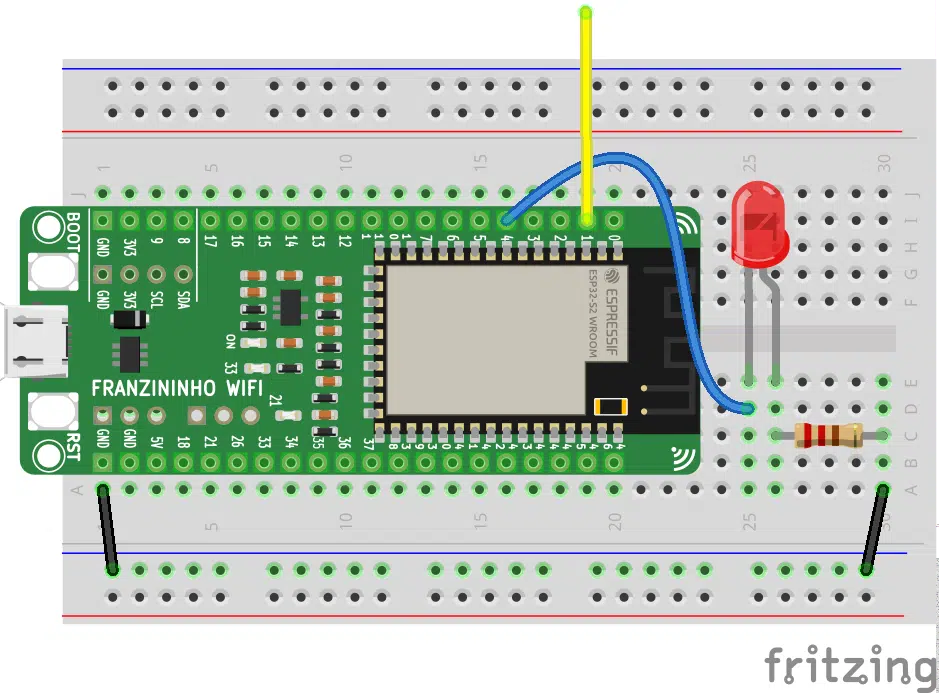
Make the following assembly for this project. In place of the capacitive touch "sensor", you can use a jumper wire, a piece of wire, or any other material.
Code
Implement the code below and test your circuit.
# Capacitive Touch

import board
import touchio
from digitalio import DigitalInOut, Direction
from time import sleep

state = 0

pin = board.IO1
touch = touchio.TouchIn(pin)

led = DigitalInOut(board.IO4)
led.direction = Direction.OUTPUT

while True:
    if touch.value:
        state = not state

    led.value = state
    sleep(1)
After finishing editing the code, save it. Run the program. When you approach or touch the "sensor" you chose, it should work as a switch, turning the LED on and off.
Code Analysis
To access the board pins we must import the board module:
import board
To use the capacitive touch pins, we will use the touchio library:
import touchio
And to configure the LED as a digital output, we need to import the DigitalInOut and Direction functions from the digitalio module:
from digitalio import DigitalInOut, Direction
Finally, we call the sleep function from the time module, which we will use for timing intervals:
from time import sleep
After importing the necessary libraries, we create a state variable that will store the LED state:
state = 0
Now, we will configure GPIO1 as a touch pin. First, we assign this pin to a variable, in this case the pin variable. After that, we create the touch object and assign the pin to this object:
pin = board.IO1
touch = touchio.TouchIn(pin)
We also assign GPIO4 to the led variable and configure it as a digital output:
led = DigitalInOut(board.IO4)
led.direction = Direction.OUTPUT
Next, we create an infinite loop (while True). Inside the loop, we check if there was a change in the capacitance of the "sensor". If the change occurs, the LED state will also change:
while True:
    if touch.value:
        state = not state

    led.value = state
    sleep(1)
How to adjust touch sensitivity?
In this example, we are triggering the LED just by approaching a finger. However, you may want to adjust your "sensor" to trigger only on contact. To do this, we will use the threshold command.
First, let's check the raw touch measurement. For this, we use the raw_value function. Then we adjust the sensitivity so that it is triggered only by actual touch:
pin = board.IO1
touch = touchio.TouchIn(pin)
print(touch.raw_value)
touch.threshold = 17300
After adding the threshold function, the LED is only triggered if we actually touch the "sensor". This happens because we configured it with lower sensitivity — i.e., a higher minimum capacitance value — so that the change is perceived by the board.
Conclusion
We learned, through a practical example, how to use a capacitive touch pin. In many situations this can be used to replace buttons and switches, presenting a simpler solution since its operation is not mechanical. Additionally, we saw how to adjust the sensitivity of this sensor to our needs.
| Author | Mateus Adriano Ventura Vieira |
|---|---|
| Date: | 06/05/2022 |